How to achieve Likeness In A Portrait
2008-04-08

In todays portrait-class I asked myself, what it is, that makes a drawing look like the person that you have drawn. What do you have to consider when you want to achieve resemblance, which factors are important? I did some experiments and found out some pretty interesting things.

It’s not about the proportion

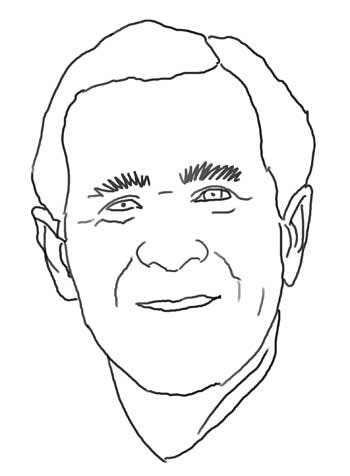
Just look at the picture to the right. Can you recognize this person? I drew exactly over a photo of him, so the proportion should be quite correct.

Nevertheless it’s not that easy to realize who this person is supposed to be. In fact, this portrait sucks pretty much even if the proportions are correct.

Besides caricatures wouldn’t work, if the proportions where that important for recognizing a face.

For example look at the great paintings of Sebastian Krüger. In most of his caricatures the proportions are completely displaced but you still won’t have any problem to identify the persons caricatured.

It seems like the relation between the size and distance of parts of the face are not that important for the recognition value of a face.
Who is this?

Creating Likeness in a Portrait

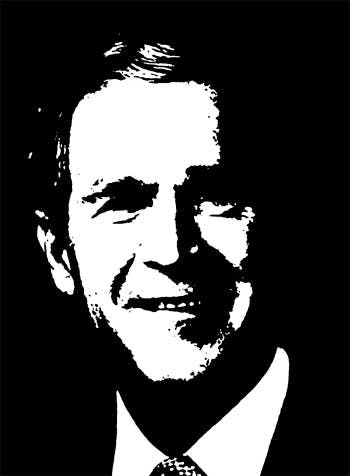
Now take a look at this picture. This time it should be quite easy to identify the person.

Is is because we can see more of the detail?

No. Even if you squint your eyes, making your view blurred you will still be able to recognize the person.

So it must have something to do with the light!

Yes and no. It’s not the light itself. If you could recognize a person because of the light, it would depend on the lightning, if you are able to identify someone or not. But you can identify a face you know under nearly every lightning condition.

But the light shows you something else. Something we didn’t saw in the first line-drawing. It shows you the 3-dimensional volume of the face.

Everyone is able to identify someone from nearly every angle. Our brains seem to recognizes faces independently from the perspective in which we are seeing it. Our brains don’t remembers certain outlines, they remember the 3-dimensional form and the volume.

Edges, corners, dints, furrows, coves, convex- and concavities. The ups and downs of a (sur-)face, how it arches and dips. All this characterizes a form. In case of a face this is what creates its likeness.

This is why it is so hard to recognize the person from the shitty line-drawing above, which just shows outlines, but gives only a few clues about the 3-dimensional form itself.

But drawing lines along the shadow borders just don’t mean you are doing a good portrait.

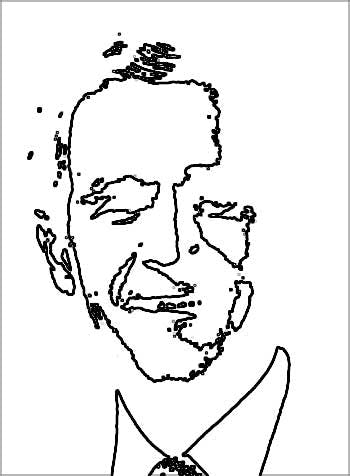
This picture shows the outline of the black & white picutre above.

Though the lines are running exactly along the shadow borders of the above picture, the likeness is completely destroyed. This kind of drawing just don’t make sense to our brain.
Who is this?
Who is this?

How to line-draw a portrait

The line-drawing above shows you why computers can’t do art. A good drawing is neither made by just following the major outlines of a face, nor by following a shadow border.

Neither do you have to draw every single change of direction in the face nor can you just draw lines around the eyes, mouth and nose. You have to find the big and the important shapes and forms and you have to find lines to describe them 2-dimensional.

But don’t think 2-dimensional. Try to imagine how the lines are running into the room, try to push them into the space.

Eyes or mouth are often drawn just as flat forms, but they got a volume that is important for their recognition, so you have to draw it. If the eyes of your drawing don’t look like the ones from your model, you probably just didn’t capture their subtle form and shape or gave no attention to their volume.

That’s also why it’s so difficult to draw from a photo. You tend to draw just 2-dimensional shapes, ignoring the 3-dimensional form of the object. But you have to paint the volume.

The more you are able to draw the volume instead of just flat shapes, the more you will notice, that your drawings will come to life, get more personality and will be easier recognized.

Trying to rescue a drawing by shading it fails most of the time. This is because if your lines don’t capture the form correctly, a shading won’t undo this mistake. So try to draw a face and only if the drawing works start shading it.


How to draw a person from a photo

Don’t try to draw from just one photos. Try to get as much photo as possible of the person you are going to draw. The more references you have, the better you can try to understand the 3-dimensional form of the face.

Try to imagine the head in 3 dimensions while drawing. Don’t just copy a photo.


A last hint for caricatures

Try to exaggerate the 3-dimensional forms instead of 2-dimensional shapes. This will make your caricatures look much more realistic and increase the likeness of them.


A little bit about me

My name ist Marcus Blättermann.
I’m majoring in communication design and work as a freelancer for illustration, print- & webdesign. If you like my work you can .

What you should do next

Don’t forget to subscribe to my RSS-Feed and follow me on Twitter. You should also check out my Portfolio.

If you didn’t liked this oneYou will hate these

There are 13 comments

  1. Drawings

    April 9, 2008
    6:39 am

    Hehe nice choice of drawing, but i wouldn’t want to spend many hours looking at that face

  2. essenmitsosse

    April 13, 2008
    12:31 am

    This was just an example. I think this is going to work with every face.

  3. God

    April 27, 2008
    8:01 pm

    Sup dude? I fancy your art.

  4. Kaete

    May 5, 2008
    5:59 am

    Comments on this blog are totally wrong! I am a professional portrait painter and have been for over 40 years. Proportion IS everything when it comes to likeness. That is ALL likeness is. The reason tracing over the photo didn’t work was because the tracing was too crude.

    To become a portrait painter you must spend years in courses and practice such as life drawing. The nude figure is studied extensively because we each one of us, even those who have no art training at all have extensive knowledge of the human body. If someone has a tooth ache, for example, their cheek might be swollen and deformed only 1/16 of an inch or less. Our eyes pick up on this deformation immediately.

    When a portrait painter does the drawing of a portrait he or she does not take out a ruler to check measurements, that is impossible. We draw and we use our feelings to decide if it is right just as everyone can tell a swollen cheek or other body part. In our training we learn use our eyes and translate that into what we see.

    Portrait painting is a wonderful much over looked branch of fine art. Practice it and you WILL get somewhere with time and you will find great joy in studying people.

  5. essenmitsosse

    May 5, 2008
    11:15 pm

    Kaete, thanks for you comment. Glad to have a real professional here.

    But there are some things, that are confusing me:
    If proportion where everthing in portrait, how do Carcatures look like? Why can I sometimes get the proportions a little bit wrong and there is still more likeness, than in a drawing with perfect proportions?

    I traced the picture above pretty precisely in terms of proportions. I thank more precisely than you would get them when drawing from life. Still there is absolutly no likeness.

    On the other hand I noticed that getting the 3-dimensional form correct and look for the right angles this adds much, much more to the likeness, than the most perfect proportions could ever do.

    Also remember, this post wasn’t an insult against portrait painters, it was just what I thought about what I observed.

    And I would never deny the importance of training and practice.

  6. Coalallith

    May 8, 2008
    1:14 am

    thats for sure, bro

  7. Tim

    May 19, 2008
    8:24 am

    Greets, people. : )

    I was surfing and I came across your site, I just thought I’d say there’s an argument for both your cases. I believe our eyes focus on the bigger things such as planes of the cheeks and forehead, chin, etc, and our mind emphasizes those aspects of people we remember, we remember so and so has a large forehead, I think that contributes to caricatures (which is the right spelling, by the way. ^_-) being able to capture a sense of likeness. Combining proper proportion while imagining someone in 3D planes instead of 2D achieves the highest sense of what someone actually looks like.

    I’ve heard before that portrait artists who are at the top of their class get their drawing right, then tweak certain aspects in order to make their rendering look more like the person than the actual person. I guess, think of it as taking a normal portrait and adding just a hint of what sticks out about that person, their eyes just a hint wider, forehead larger, etc. That doesn’t really have anything to do with the likeness argument, but it was interesting none the less, that an artist can take something in front of him and take it a step farther.

    I enjoyed your article. : ) much peace.

    -Tim

  8. Roger

    November 28, 2008
    1:06 pm

    This is a really interesting article. Thanks for writing it. I have been struggling to find the link between classic portraiture and caricature and you made some excellent points. I will have to give it another read through and see if I can apply some of it.

    roger

  9. I’ve just finished a series of self-portraits. In each of them, I’m sure that the proportions of my face have been correctly stated. I have noticed, however, that the best likeness is the one in which I have not overworked the individual features of the face. This observation reminds me of the fascination I feel at being able to recognise faces which I have hitherto only seen as pixilated photographs. In other words I feel that most of a human likeness lies in the most basic masses of the head and face and not the details.

  10. Shelley Rothenburger

    June 15, 2009
    7:59 pm

    I teach portraiture classes and I have learned over the years that yes porportion is very important to individual likeness in portraits but this basic observation isn’t nearly all thats needed to create a likeness. At least not for the kind of portraits I am interested in. If you look at the most important portrait artist of all time, Rembrandt, you will discover that he was very much interested in extending his observation of sitters past porportion to unique details of their features which would include wrinkled eyes, pock marked skin, bulbose shaped noses, distinct textures in skin and hair, lined faces, concave cheeks, bags under eyes, etc. He was very much about representing the personality and character of his subjects and to do this he had to look very closely at individual aspects of the persons face and evidence of their lifes revealed in their faces. He was a master at this and he learned it in mostly in his own face with self portraiture. So it really depends on how objective or subjective you want to be in your portrayal of the subject.

  11. Shelley Rothenburger

    June 15, 2009
    8:17 pm

    I teach portraiture classes and I have learned over the years that yes proportion is very important to individual likeness in portraits but this basic observation isn’t nearly all thats needed to create a likeness. At least not for the kind of portraits I am interested in. If you look at the most important portrait artist of all time, Rembrandt, you will discover that he was very much interested in extending his observation of sitters past proportion to unique details of their features which would include wrinkled eyes, pock marked skin, bulbose shaped noses, distinct textures in skin and hair, lined faces, concave cheeks, bags under eyes, etc. He was very much about representing the personality and character of his subjects and to do this he had to look very closely at individual aspects of the persons face and evidence of their lifes revealed in their faces. He was a master at this and he learned it in mostly in his own face with self portraiture. So it really depends on how objective or subjective you want to be in your portrayal of the subject.

  12. Catt of the Garage

    November 25, 2009
    3:09 pm

    This is a great article, it helps me a little further on the road to understanding what makes likeness; and so do the comments, which have some very good points too.

    Likeness is a little like reading, isn’t it? As if your brain is set up to look for certain aspects of a face – the way it looks for certain features of a letter – and if enough of those aspects are there and correct, a little lightbulb goes on – “That’s an ‘A’”! or “That’s George!”. The problem is, it’s easy to find out what matters when drawing a letter, because there’s only so much you can change, but faces are so much more complicated. I can see I’ll spend the rest of my life trying to figure this out…

  13. mike

    April 25, 2010
    1:40 am

    Im glad there is someone out there studying these types of elements that create realism,im only a teenager ,but I’ve always had trouble making a face flawless.some of the things you’ve analized will help me for future portraits.thanks a lot.

Leave a comment